Can a Hostess Earn From a Table She Never Sat At?
For one Tokyo club’s mama, the answer depended on whose customer it was, not on whether she was in the room.
Fictional AI-generated depiction. No person or venue in the sources is pictured.
In a 2015 Tokyo District Court decision, a club’s mama could earn from her own customer’s spending even if she was not at work that night. If she came in and greeted someone else’s customer, that greeting did not increase her pay. Both events could happen in the same room. Only one changed her compensation under the arrangement the court examined.
The case was about a dismissal dispute: was this particular woman a worker under Japan’s Labor Contract Act? The court looked at who directed her work, how much control she had over when she came in, and how she was paid. It found that sales to her own customers formed the basis of her compensation. It did not treat the title mama as enough to decide her status. It ruled that she did not qualify as a worker under that Act on these facts. This was one arrangement from 2014, not a ruling about all hostesses or evidence of current pay levels. 1
Who gets credit for a guest?
Spend a moment with the difference between the two nights. On the first, the mama is absent and a customer associated with her orders at the club. On the second, she is visible at another table, doing the work of making someone feel welcome. The court’s account tells us which of those events affected her pay. It does not tell us which demanded more effort or which mattered more to the guest.
That distinction helps explain why a high bill is so easy to misread. A receipt can show a charge, but who gets credit for the sale is a separate question. What that credit means for pay is another. Looking at the total cannot answer either question on its own.
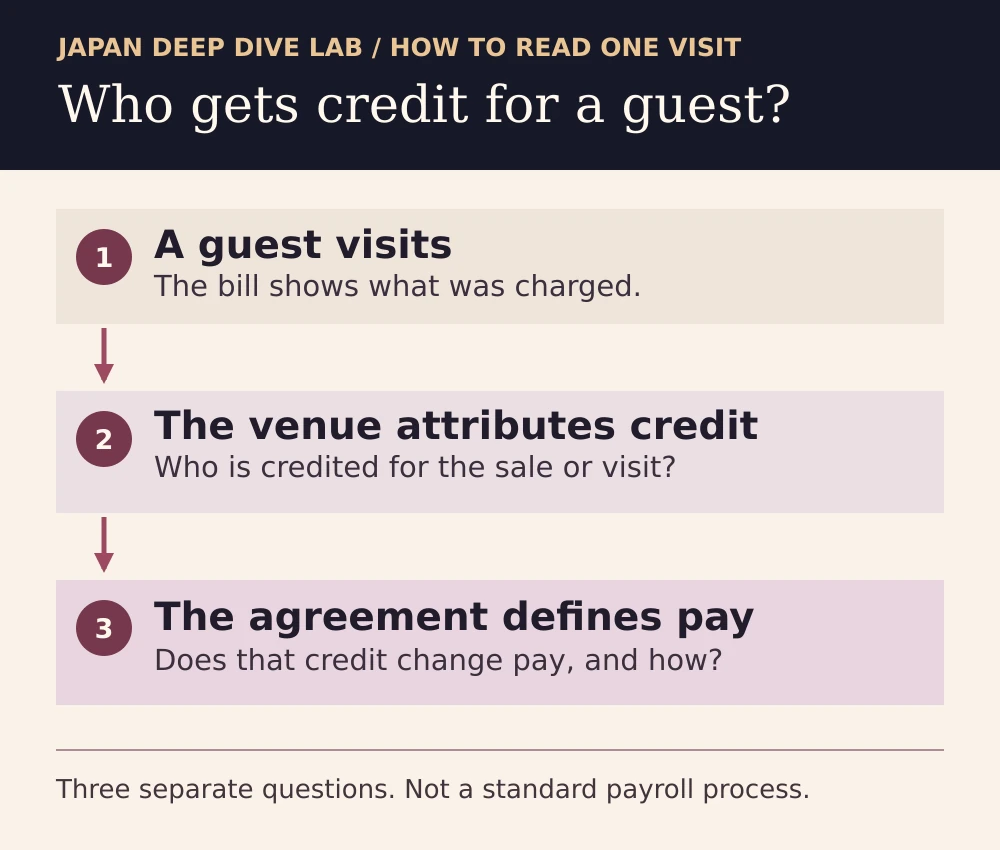
Editorial diagram. It shows questions to ask, not a standard payroll process.
Three different windows into the work today
A venue advertising pay. One Akasaka kyabakura lists an hourly rate with bonuses alongside a sales-based calculation, and says the venue compares them. It lists a guest’s advance request for a particular worker separately from a request made once the guest is already in the room. The distinction is in the public recruitment terms. We do not have a pay record showing what anyone received. Nor is this the venue in the 2015 decision. 2
A team sharing a table. A separate Ginza club describes how an assigned hostess can help decide which colleague joins the table. Its mama also considers which guests suit the colleague’s strengths. The club describes how an advance reservation or an accompanied visit may be credited and how the mama can award extra performance credit. Someone can contribute to the conversation without being the person who brought the guest in. The venue’s explanation is about its own performance system; it does not establish how a credit translated into cash. 3
A worker getting the next visit onto the calendar. In a 2026 interview, a Kabukicho hostess described leaving room for a return visit rather than trying to prolong every first encounter. She also described checking tentative plans again by message the next day. The interviewer worked for the same venue group, so this is her account of a choice, not an independent audit or a guide to how everyone works. It does show that, for her, part of getting a guest to return happened after the visible conversation was over. 4
These accounts explain different things: one court examined a particular contract, one venue advertises pay, one venue describes how it assigns credit, and one worker explains why she follows up. None of them is a substitute for the others. Put side by side, they give us a better way to read a night at the table: ask who got the guest to return, who did the work in the room, and what the agreement actually rewards. Those answers can point to different people.
Which part would you like to read more about: pay, customer relationships, or work away from the floor? If you arrived from a social post, tell us in the replies to that post.
Sources
- Japan Ministry of Health, Labour and Welfare, reference collection on worker status, case 9, pp. 42–44. Tokyo District Court, 5 November 2015; individual facts from 2014.
- Akasaka venue, published recruitment terms. Undated operator material; checked 24 November 2026.
- Ginza club, published explanation of its assignment and credit system. Undated operator material; checked 24 November 2026.
- Modelpress interview, syndicated full text, 20 November 2026.
Draft and source check: 24 November 2026. The sources document separate cases or claims. They do not establish typical pay. No original interviews were conducted for this article.